
What Is a Solarium and How Is It Different From a Sunroom?
This post was originally published on September 18, 2020
If you’ve been exploring ways to expand your living space, you’ve probably come across terms like sunroom, screen room, solarium, and conservatory. These words are often used interchangeably, but they actually describe very different structures — with different costs, maintenance demands, and comfort levels. For Texas homeowners in particular, the differences matter a great deal.
Understanding the distinctions is key to choosing the option that best fits your lifestyle, budget, and the Texas climate. At Sunspace Texas, we specialize in creating custom outdoor living solutions ranging from screened porches to year-round insulated sunrooms. Let’s break down how solariums, sunrooms, conservatories, and greenhouses compare — and why most Texas homeowners choose the Sunspace sunroom system.
What Is a Solarium?
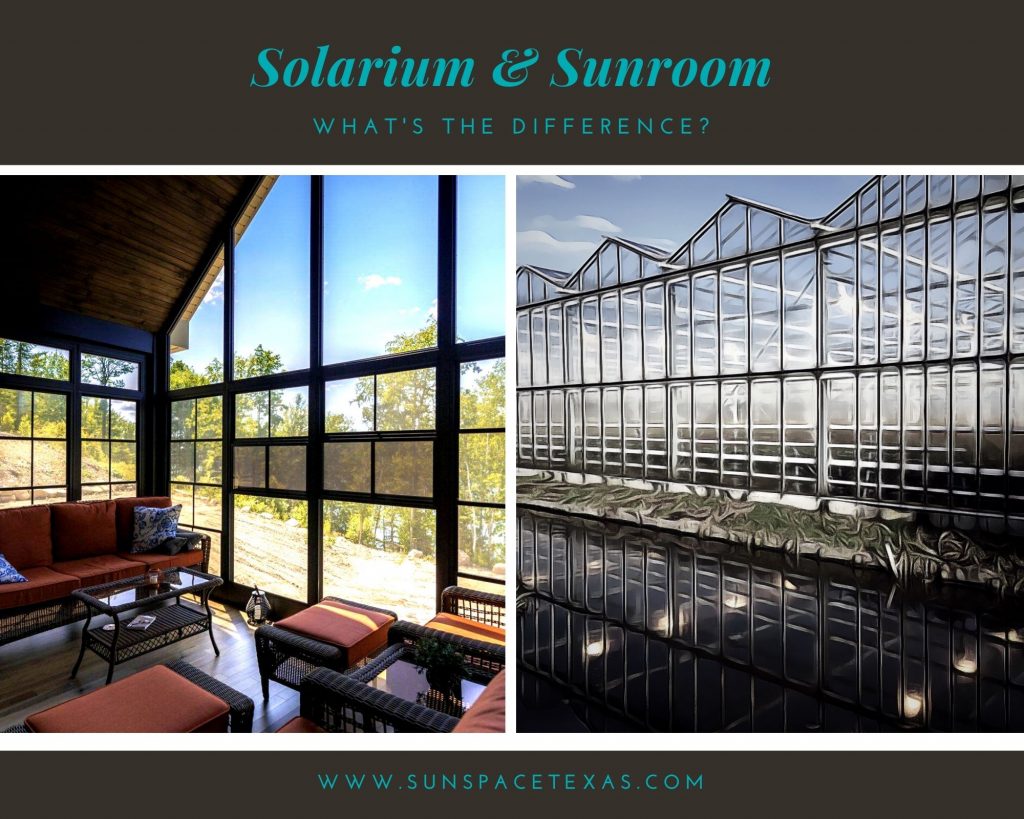
A solarium is a type of glass enclosure designed to capture as much natural light as possible. Constructed with glass walls and a glass roof, a solarium creates the feeling of being outdoors while staying protected from rain, wind, and pests. The word “solarium” comes from the Latin sol, meaning sun — and maximizing sunlight is its entire purpose.
Solariums are popular with homeowners who want to use the space for growing plants, stargazing, or enjoying panoramic sky views. In cooler climates they can be a dramatic architectural feature. In Texas, however, the all-glass design creates serious practical challenges we’ll cover below.
Solarium Advantages
- Full glass walls and ceiling create an immersive, panoramic outdoor experience
- Ideal for stargazing, watching storms, or enjoying 360° landscape views
- Floods the space with natural light — excellent for growing tropical plants, herbs, or flowers
- Adds dramatic architectural flair and curb appeal to a home
- Passive solar heating potential in winter months
Solarium Disadvantages
- Overheats severely in summer — especially in Texas
- High maintenance: glass roofs require frequent cleaning (pollen, bird debris, shingle residue, ice)
- More expensive to build and maintain — typically $30,000–$75,000+ depending on size and glass quality
- Less energy-efficient, leading to significantly higher cooling and heating costs
- Glass roofs are vulnerable to hail, high winds, and seal failure over time
- Custom blinds or shading systems often required — adding further cost
- Warranties are typically limited (often 10 years, non-transferable on glass components)
Types of Solarium Designs
Not all solariums look the same. If you’re researching the category, you’ll encounter several distinct styles — each with different aesthetics, price points, and structural requirements.
Straight-Eave (Lean-To) Solarium
The most common and affordable style. A single-slope glass roof attaches to an existing exterior wall of the home. Space-efficient and well-suited to smaller properties, though the flat pitch can make water drainage and cleaning more challenging.
Curved-Eave Solarium
Features a gently curved glass roof that adds architectural elegance. The curved profile improves water runoff and gives the room a softer, more organic appearance. Popular for mid-range residential projects.
Cathedral-Style Solarium
A peaked, gabled glass roof resembling cathedral architecture. Creates impressive height and a grand, dramatic interior. Best suited to larger homes where the scale doesn’t feel out of proportion.
Freestanding Solarium
Not attached to the main house — functions more like a glass pavilion or garden room in a yard. Requires its own foundation and utilities run to the structure. Higher cost but offers complete design flexibility.
A note for Texas homeowners: Regardless of style, every solarium design shares the same fundamental challenge in our climate — a glass roof that faces the Texas sun will trap heat. No design type solves this problem without significant HVAC investment, specialized glazing, and shading systems.
Solarium vs. Sunroom vs. Conservatory vs. Greenhouse: What’s the Difference?
These four terms are often confused, but each describes a genuinely different structure with different materials, purposes, and comfort levels.
Solarium
All-glass walls and roof designed to maximize natural light and provide panoramic views. Can be heated and cooled, but the glass construction makes climate control expensive and difficult. Solariums are used as living spaces, not for plant cultivation.
Sunroom
A room addition featuring large windows or vinyl panel walls with a solid insulated roof. Designed for year-round comfort, sunrooms offer abundant natural light without the thermal extremes of an all-glass structure. They can function as a three-season room or, with full insulation and HVAC integration, a true four-season living space.
Conservatory
Similar to a solarium in that it uses glass walls and roof, but conservatories traditionally prioritize ornate, Victorian-style aesthetics — think decorative finials, intricate ridge details, and elegant ironwork. Climate control systems are typically built in. Conservatories are more common in the UK and northern Europe; in the U.S. the terms “conservatory” and “solarium” are often used interchangeably.
Greenhouse
Designed primarily for plant cultivation, not human comfort. Greenhouses use transparent materials (glass or polycarbonate) to trap warmth and regulate temperature and humidity for optimal plant growth. They are not insulated for human occupancy, lack comfortable flooring or furnishings, and are not considered living spaces.
The key distinction: solariums and conservatories prioritize light and views for people; greenhouses prioritize controlled growing conditions for plants; sunrooms prioritize year-round human comfort with practical insulation and weather resistance.
What Is a Sunroom?
A sunroom also brings sunlight indoors, but it’s far more practical for everyday living. Instead of full glass walls and ceilings, a sunroom combines large windows, screens, and doors with a solid insulated roof. The result is a bright, comfortable room that functions like true living space in any season.
At Sunspace Texas, we design sunrooms with customizable options including:
- WeatherMaster® Windows & Doors — vinyl panels that block 99% of UV rays
- Acrylic Patio Covers — for filtered natural light without heat gain
- Walls-Under Systems — to convert existing decks into fully enclosed spaces
- AlumaDeck® Flooring — slip-resistant and waterproof
- Aluminum Railings — complement decks or stairs in multiple finish options
A Note on Glass and Panel Technology
Not all glass performs the same in the Texas heat, and the glass or panel system in your sunroom is one of the most important decisions you’ll make. Our WeatherMaster® vinyl panels are engineered specifically for high-UV, high-heat environments — blocking 99% of UV rays while maintaining clear views. For homeowners considering glass upgrades, options like Low-E glass (which reduces heat transfer while allowing light) and double-pane insulated glazing can dramatically improve comfort and reduce cooling costs compared to standard single-pane glass. This is a significant advantage over all-glass solariums, where the roof glass creates a heat-trap effect that even the best HVAC systems struggle to overcome in a Texas summer.
Sunroom Advantages
- Comfortable year-round with insulation and ventilation
- Lower maintenance compared to full glass construction
- Versatile: can be used as a dining area, home office, yoga studio, playroom, entertainment space, or breakfast nook
- Scalable: start with a patio cover and later upgrade to screens or vinyl windows without losing your investment
- Engineered to exceed Texas building codes — designed to handle high winds and severe storms
- Lifetime transferable warranties available on many Sunspace components, adding resale value
Sunroom Disadvantages
- Doesn’t offer a complete 360° glass view like a solarium
- May require skylights or acrylic roof panels if you want overhead natural light
Solarium vs. Sunroom vs. Conservatory — Comparison Chart
| Feature | Solarium (All Glass Room) | Sunroom (Sunspace System) | Conservatory |
|---|---|---|---|
| Walls and Roof | Glass walls and glass roof | Solid insulated roof with WeatherMaster® vinyl windows | Glass walls and glass roof with ornate framing |
| Frame Options | Custom aluminum framing | Sunspace powder coated aluminum in multiple colors | Aluminum, wood, or uPVC with decorative details |
| Glass or Panel Options | Double pane insulated glass | WeatherMaster® vinyl panels, acrylic roof panels, Low E glass upgrades | Double pane or Low E glass, often tinted |
| Energy Efficiency | Low with heat gain in summer and poor insulation in winter | High with insulated roof and energy efficient panels | Low to moderate depending on climate control systems |
| Customization | Limited because structure must remain all glass | Multiple options including screen rooms, patio covers, railing, and decking | Moderate style variations with fixed glass structure |
| Maintenance | High with glass cleaning and seal maintenance | Low with easy clean vinyl panels | High due to glass and decorative detailing |
| Durability | Glass vulnerable to hail and wind damage | Engineered for strong structural performance | Varies by manufacturer and materials |
| Typical Cost | $30,000 to $75,000 or more | More budget friendly and scalable | $20,000 to $80,000 or more depending on style |
| Warranty | Often around 10 years on glass | Lifetime transferable warranty on many components | Varies by manufacturer |
| Best Uses | Stargazing, indoor gardens, architectural showpiece | Family room, entertaining space, office, breakfast nook, yoga studio | Elegant living space or plant display |
Which Is Best for Texas Homes?
While solariums and conservatories are beautiful, the Texas climate makes them impractical for most homeowners. The core problem is orientation and physics: a glass roof facing the Texas sun — regardless of which direction it faces — will absorb and trap heat at levels that standard HVAC systems can’t offset cost-effectively.
Orientation matters, but doesn’t solve the problem. In principle, a south-facing glass room captures maximum winter sun; an east-facing room gets gentler morning light; a west-facing room gets intense afternoon heat; and a north-facing room gets consistent indirect light with less overheating. But in Texas, even the most favorably oriented all-glass room will experience summer temperatures that make the space uncomfortable without constant, expensive cooling — and without custom motorized blinds or shade systems that add thousands to the project cost.
Ventilation workarounds are expensive and imperfect. Homeowners who do install solariums typically need to add operable roof vents, ceiling fans, retractable shade systems, and upgraded HVAC capacity. Each of these is an additional expense on top of the already higher base cost of a solarium, and they address symptoms rather than the underlying thermal challenge of an all-glass roof.
Sunspace sunrooms, by contrast, are designed from the ground up with the Texas climate in mind. The solid insulated roof eliminates the overhead heat-trap. WeatherMaster® vinyl panels block 99% of UV rays. The modular system lets you start with a patio cover, add screens, and later upgrade to fully enclosed vinyl window walls — all without losing your initial investment. Whether you’re in Houston, Dallas, San Antonio, or anywhere across the state, you’ll get a space that’s genuinely comfortable year-round.
Ready to explore your options? Contact Sunspace Texas today for a free consultation and discover how a custom sunroom can transform your outdoor living space.
Sunroom vs. Solarium: Which Adds More Home Value?
For Texas homeowners, a well-built sunroom consistently delivers a stronger return on investment than a glass solarium. Here’s why: sunrooms add desirable, usable square footage at a relatively lower cost than a full room addition — and because the space is comfortable year-round, buyers see it as genuine living space, not a seasonal novelty. Sunspace systems with lifetime transferable warranties are especially attractive to buyers, who inherit the warranty coverage when they purchase the home.
Solariums do add a “wow factor” that can appeal to certain buyers, but in a hot climate like Texas, a prospective buyer who walks into an overheated all-glass room in July is more likely to see a liability than an asset. Solarium glass warranties are also typically limited to 10 years and are non-transferable — meaning the next owner has no coverage. In cool climates with mild summers, the calculus can be different; in Texas, the practical sunroom almost always wins on ROI.
Frequently Asked Questions (FAQs)
Is a solarium the same as a sunroom?
No. A solarium is an all-glass structure — walls and roof — designed to maximize natural light and panoramic views. A sunroom combines large windows or vinyl panel walls with a solid insulated roof, making it far more practical for everyday use in the Texas climate. While the terms are sometimes used interchangeably in casual conversation, they describe meaningfully different rooms with different costs, maintenance requirements, and comfort levels.
What is the difference between a solarium, a conservatory, and a greenhouse?
A solarium is an all-glass room designed for human use — relaxing, entertaining, or enjoying views. A conservatory is similar but traditionally features ornate Victorian-style architectural details and is more common in the UK; in the U.S., the terms are often used interchangeably. A greenhouse is designed primarily for plant cultivation, not human comfort — it uses transparent materials to regulate temperature and humidity for growing, and is not intended as a living space.
Which is better for Texas heat: a solarium or a sunroom?
A sunroom is significantly better for the Texas climate. Its solid insulated roof prevents overhead heat gain, and WeatherMaster® windows block 99% of UV rays — keeping the space cool in summer and warm in winter without excessive HVAC costs. A solarium’s glass roof traps heat at levels that are very difficult and expensive to manage in a Texas summer, no matter how the room is oriented or ventilated.
Are solariums more expensive than sunrooms?
Yes, considerably. A quality solarium typically costs between $30,000 and $75,000 or more, depending on size, glass type, frame material, and HVAC requirements. That’s often two or more times the cost of a comparable Sunspace sunroom — and the ongoing maintenance and energy costs for a solarium are also significantly higher. Sunspace sunrooms are also modular, meaning you can build in stages rather than paying for everything upfront.
Can a solarium be used year-round in Texas?
Technically yes — if you invest in high-quality double-pane or Low-E glass, a robust HVAC system, motorized shade blinds, and operable roof vents. In practice, most Texas homeowners find that the cost and effort required to make a solarium comfortable year-round exceeds the value of the all-glass aesthetic. A four-season sunroom with an insulated roof achieves true year-round comfort far more reliably and economically.
What are the different types of solariums?
The main solarium styles are: straight-eave (lean-to) — the most affordable, with a single-slope roof attached to an exterior wall; curved-eave — a gently curved glass roof with better water runoff and a softer appearance; cathedral-style — a peaked gabled roof with impressive height and grandeur; and freestanding — a standalone glass structure not attached to the house, requiring its own foundation. All styles share the same fundamental challenge in the Texas climate: a glass roof that traps heat.
How much does a sunroom cost in Texas?
Sunspace sunroom costs vary based on size, configuration, and features, but the modular system is designed to be scalable — you can start with a basic patio cover and add screens, vinyl windows, or full enclosure panels over time. This makes sunrooms accessible at a range of budgets compared to the $30,000–$75,000+ entry point for a solarium. Contact us for a free consultation and no-obligation quote tailored to your specific project.
Do I need a permit for a sunroom or solarium in Texas?
Most Texas cities require permits for structural additions like sunrooms and solariums. Requirements vary by municipality. At Sunspace Texas, we handle all drawings, permit applications, inspections, and building code compliance on your behalf — so you don’t have to navigate the process alone.
Can I start with a patio cover or screen room and upgrade later?
Yes — this is one of the most significant advantages of the Sunspace system. Because it’s fully modular, you can start with a patio cover, add screens, and later upgrade to vinyl window panels or a fully enclosed four-season sunroom without losing your earlier investment. Each stage of investment builds on the last.
Are sunrooms energy efficient year-round?
Yes. Sunspace sunrooms feature solid insulated roofs, WeatherMaster® vinyl panels that block 99% of UV rays, and proper ventilation design. Combined, these elements keep the space comfortable across all four Texas seasons without the extreme HVAC costs associated with all-glass rooms.
Which adds more home value: a solarium or a sunroom?
In Texas and other hot climates, a well-insulated sunroom typically adds more resale value than a glass solarium. Sunrooms add usable year-round living space at a lower cost, and buyers recognize the practical value. Sunspace components with lifetime transferable warranties are especially attractive to buyers. Solariums, while visually dramatic, can deter buyers who anticipate high maintenance and utility costs — particularly in a state with summers as intense as Texas.
What is the lifespan of a solarium?
A well-built solarium can last 20–30 years, but the glass components — especially the roof — are the limiting factor. Glass roof seals are susceptible to failure over time, and replacement is expensive. Most solarium glass warranties are limited to 10 years and are non-transferable to future owners. Aluminum frames, if properly maintained, can last longer. By comparison, Sunspace sunroom frames and vinyl panels are designed for long-term durability with minimal maintenance, and many components carry lifetime transferable warranties.